
Note: This article was originally posted on May 22, 2018, and was updated on July 13, 2026.
Note: For clients who were asked to read this article to measure their waist circumference and hip circumference in advance of their assessment visit, drop down to where the first red asterisk (*) is, and read all three sections marked with a red *
Is Weighing Yourself the Best Way to Assess Health?
Most people weigh themselves, looking for a specific “number” on the scale with the belief that a “healthy weight” is the best way to assess risk; however, waist-to-height ratio provides much more useful information.
While people may feel best at a certain weight, knowing where on their body they are carrying that fat sheds light on metabolic risk.
Does BMI Reflect Risk?
Body Mass Index (BMI) is calculated by dividing a person’s weight in kilograms by their height in meters squared [4], and categorizes people as normal weight, overweight, or obese. While BMI can be helpful, it does not always reflect a person’s health risk because BMI doesn’t indicate where on a person’s body that fat is stored.
Fat stored deep in the abdomen (visceral fat) is associated with the highest risk [4,5].
Is BMI Different For Asians and South Asians?
Yes, BMI cutoffs for Asians and South Asians are set lower than those of European descent because for these individuals, metabolic risk (type 2 diabetes, heart disease) generally occurs at lower BMIs.
Below are the standard recommended BMI thresholds for those of European descent and those of Asian or South Asian descent, according to the World Health Organization (WHO) [7] and Diabetes Canada [9]:
| Category | Standard BMI (kg/m²) | Asian / South Asian BMI (kg/m²) |
|---|---|---|
| Underweight | < 18.5 | < 18.5 |
| Normal weight | 18.5 – 24.9 | 18.5 – 22.9 |
| Overweight | 25 – 29.9 | 23 – 27.4 |
| Obese Class I | 30 – 34.9 | 27.5 – 32.4 |
| Obese Class II | 35 – 39.9 | 32.5 – 37.4 |
| Obese Class III | ≥ 40 | ≥ 37.5 |
What is Waist-to-Height Ratio?
Waist-to-Height Ratio (WHtR) compares a person’s waist measurement to their height measurement. Studies have found that WHtR is a more accurate way of identifying health risk compared to BMI [1,2] because it reflects the fat stored in and around a person’s organs. This “Central fat” is closely linked with metabolic illness, including heart disease, high blood pressure, and type 2 diabetes [1,3,4,5].
- A 2012 meta-analysis of 31 studies found that WHtR was better than BMI at detecting cardiometabolic risks [1]
- A 2014 study showed that WHtR was more predictive of “years of life lost” than BMI [2].
- More recent studies report that people can have a normal BMI yet still be at risk if their waist is too large for their height [1,2,5].
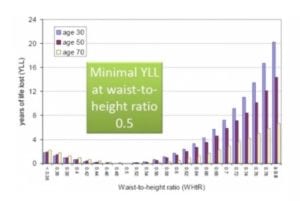
Waist-to-Height Ratio Is More Predictive of Years of Life Lost than Body Mass Index [2]
For the above reasons, waist circumference and waist-to-height ratio give a more meaningful picture of health risk, especially for adults over 30 years of age [1,2,5].
How to Calculate Waist-to-Height Ratio
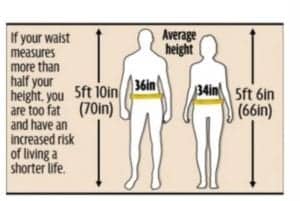
Measuring WHtR is very easy. Using the same units for both [1,2], either inches or centimeters, measure your height without shoes. Then, measure your waist circumference halfway between the lowest rib and the top of the hip bone (described below), and divide your waist measurement by your height.
*Where to Measure Your Waist
Where you measure your waist makes a difference.
For assessing health risk, the recommended place to measure is halfway between your lowest rib and the top of your hip bone (the iliac crest) [6].
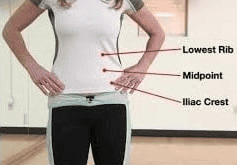
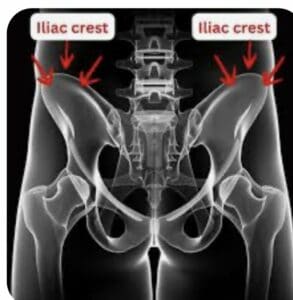
Measuring at this midpoint — rather than at the narrowest part of the waist or at the navel (belly button) ensures the reading reflects visceral fat (abdominal fat that surrounds the organs), not just subcutaneous fat (fat under the skin) [3,4,5].
Measuring the waist at this precise midpoint is especially important for those from Asian or South Asian backgrounds, because visceral fat accumulates earlier and increases metabolic risk even at lower waist sizes [7,8,9].
*How to Measure Your Waist Properly
- Use a soft tape measure, like a seamstress (sewing tape).
- Stand comfortably and relax your stomach. Do not pull it in.
- Ensure you measure exactly halfway between your lowest rib and the top of your hip bone (iliac crest).
- Make sure the tape is level all the way around.
- Measure after a gentle exhale for the most consistent result [6].
*How to Measure Your Hips Properly
Waist-to-hip ratio (WHR) is another measurement used to help assess health risk. This is how hips should be measured:
- Stand up straight and breathe out.
- Using a soft tape measure, measure the distance around the widest part of your hips.
- Make sure the tape is level all the way around.
What Are Waist-to-Height Cutoffs?
A WHtR of 0.50 or less is generally considered lower risk [1,2]. A WHtR above 0.50 suggests a higher risk of metabolic disease [1,2].
Why Pay Attention to Waist Circumference?
Knowing waist size is especially important after age 30, when body fat shifts toward the abdomen [5,6], and it is also important for those of Asian and South Asian descent, who often face higher metabolic risk at lower weights [7,8,9].
For people who already have high blood pressure, borderline or high blood sugar, elevated cholesterol, or a family history of heart disease or type 2 diabetes, paying attention to waist size is especially important [5,6].
Putting It All Together
Instead of focusing on weight or BMI, waist circumference and waist-to-height ratio give a clearer idea of health risk, especially for adults over 30 [1,2,5], and those of Asian and South Asian descent [7,8,9].
It is easy to measure and is more strongly linked with metabolic health than weight or BMI [1,2,5].
If your waist is more than half your height, it is an indication that it is time to make dietary and lifestyle changes that reduce abdominal fat, including reducing stress and improving sleep quality and quantity [1,2,5].
A scale alone does not tell the whole story. A tape measure, used in the right place, provides much more useful information [3,4,5].
Clinical Applications
I help people to understand that the amount of fat that they are carrying around their waist is of greater metabolic significance than a number on a scale.
Many of my clients find it very freeing not to have to weigh themselves all the time, but when their pants or skirts start getting loose, they grab the tape measure and assess their progress. This is especially true for those who have had many prior attempts at weight loss that focused on counting calories and weighing their food and themselves daily.
More Info
If you would like support with achieving and maintaining a healthy waist circumference, I can help. Learn about me and the Comprehensive Dietary Package that I offer.
To your good health,
Joy
You can follow me on:
Twitter: https://twitter.com/jyerdile
Facebook: https://www.facebook.com/BetterByDesignNutrition/
Quick Clinical Summary
Q: Why is Waist-to-Height Ratio (WHtR) more accurate than BMI?
A: WHtR is a better predictor of metabolic risk because it accounts for visceral fat stored around abdominal organs. People can have a normal BMI but still face high cardiometabolic risk if their waist is more than half their height.
Q: How do you calculate Waist-to-Height Ratio?
A: To calculate WHtR, divide your waist circumference by your height using the same units. A ratio of 0.50 or less is considered lower risk, while a ratio above 0.50 indicates a higher risk for metabolic diseases like type 2 diabetes.
Q: Where is the correct place to measure the waist for health risk?
A: The recommended measurement point is the midpoint between your lowest rib and the top of your hip bone (iliac crest). This ensures the reading reflects visceral fat rather than just subcutaneous fat under the skin.
References
- Ashwell M, Gunn P, Gibson S. Waist-to-height ratio is a better screening tool than waist circumference and BMI for adult cardiometabolic risk factors: systematic review and meta-analysis. Obesity Reviews. 2012;13(3):275–286. [https://pubmed.ncbi.nlm.nih.gov/22106927/]
- Ashwell M, Mayhew L, Richardson J, Rickayzen B. Waist-to-Height Ratio Is More Predictive of Years of Life Lost than Body Mass Index. PLoS ONE. 2014;9(9):e103483. [https://journals.plos.org/plosone/article?id=10.1371/journal.pone.0103483]
- Hsieh SD, Yoshinaga H. Abdominal fat distribution and coronary heart disease risk factors in men—waist/height ratio as a simple and useful predictor. International Journal of Obesity. 1995;19(8):585–589. [https://pubmed.ncbi.nlm.nih.gov/7489031/]
- Janssen I, Katzmarzyk PT, Ross R. Waist circumference and not body mass index explains obesity-related health risk. American Journal of Clinical Nutrition. 2004;79(3):379–384. [https://pubmed.ncbi.nlm.nih.gov/14985210/]
- Katzmarzyk PT, Romero-Corral A, Ross R, et al. Waist circumference, BMI, and clustering of cardiovascular risk factors in Canadian adults. CMAJ. 2009;181(2–3):E68–E75. [https://pubmed.ncbi.nlm.nih.gov/15286257/]
- Health Canada. Canadian Physical Activity, Sedentary Behaviour and Obesity Guidelines. Ottawa: Government of Canada; 2011. [https://www.heartandstroke.ca/-/media/pdf-files/healthy-living/csep_guidelines_handbook.pdf]
- Consultation WHO Expert. Appropriate body-mass index for Asian populations and its implications for policy and intervention strategies. The Lancet. 2004;363(9403):157–163. [https://pubmed.ncbi.nlm.nih.gov/14726171/]
- Misra A, Vikram NK. Waist circumference criteria for the diagnosis of abdominal obesity are not universal: a review. Nutrition. 2003;19(5):442–446. [https://pubmed.ncbi.nlm.nih.gov/15993041/]
- Diabetes Canada Clinical Practice Guidelines Expert Committee. Diabetes Canada 2023 Clinical Practice Guidelines. Toronto: Diabetes Canada; 2023. [https://guidelines.diabetes.ca/home]


I am a Registered Dietitian Nutritionist and the owner of BetterByDesign Nutrition Ltd. With a postgraduate degree in Human Nutrition and a background as a published mental health nutrition researcher, I have been dedicated to supporting my clients’ clinical needs since 2008.
I hold active professional licenses in BC (CHPBC), Alberta (CDA), and Ontario (CDO), allowing me to provide regulated Medical Nutrition Therapy across these provinces. My expertise spans chronic disease management, complex digestive health, and therapeutic diets. I am deeply passionate about helping people reclaim their health, rooted in my firm belief that Nutrition is BetterByDesign©.