
For a second week in a row dire warnings about the alleged dangers of “low carbohydrate diets” scream out from headlines across the internet.
“Low-Carb Diets Linked to Higher Risk of Premature Death”
~Newsweek August 28, 2018, 12:51 PM
“Low carbohydrate diets are unsafe and should be avoided, study suggests”
~ScienceDaily, August 28, 2018
The general public relies on journalists to thoroughly research their stories before publishing them however in the above two examples and the other incidences of reporting this story it was not indicated that (1) there was no published study (2) the story was based on researcher’s conclusions in provided materials based on an Abstract from a Poster presentation and (3) the provided materials / Abstract didn’t define the term “low carbohydrate” (# of grams of carbohydrate per day) which is central to the claims of the researchers.
The supposed link to “premature death” of a “low carbohydrate diet” were said to be part of a large study that was presented at the European Society of Cardiology (ESC) Congress 2018 in Munich, Germany, but when I went to find the journal in which the study was published so I could read it, I discovered that it’s not even been published yet. I even checked the lead author’s Publication page on ResearchGate and could not find the published study. Furthermore, the findings were not presented as one of the more than 500 Conference sessions of research studies at the European Society of Cardiology Congress, but were one of the 4,500 Abstract presentations — not even as a talk, but as a Poster Session.
 A “Poster Session” at an academic Conference is where 100s of researchers assemble in a large hall and stand in front of a poster summarizing their research. People walk by, look at the poster, and if they wish, ask questions.
Journalists wrote stories based on “materials provided to them by the European Society of Cardiology” (see story source at bottom of ScienceDaily article) which is based on the Abstract available on the website of the European Society of Cardiology’s 2018 Congress from the yet-to-be-published study by M. Mazidi (Gothenburg, Sweden), N Katsiki (Thessaloniki, Greece), DP Mikhailidis (London, Great Britain) and M Banach (Lodz, Poland) 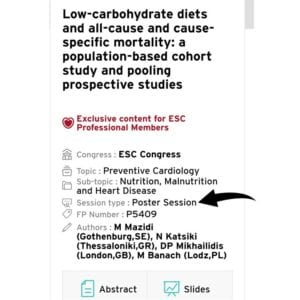 and also published the same day (August 28, 2018) in the European Heart Journal, Volume 39 Supplemental on pages 1112-1113.
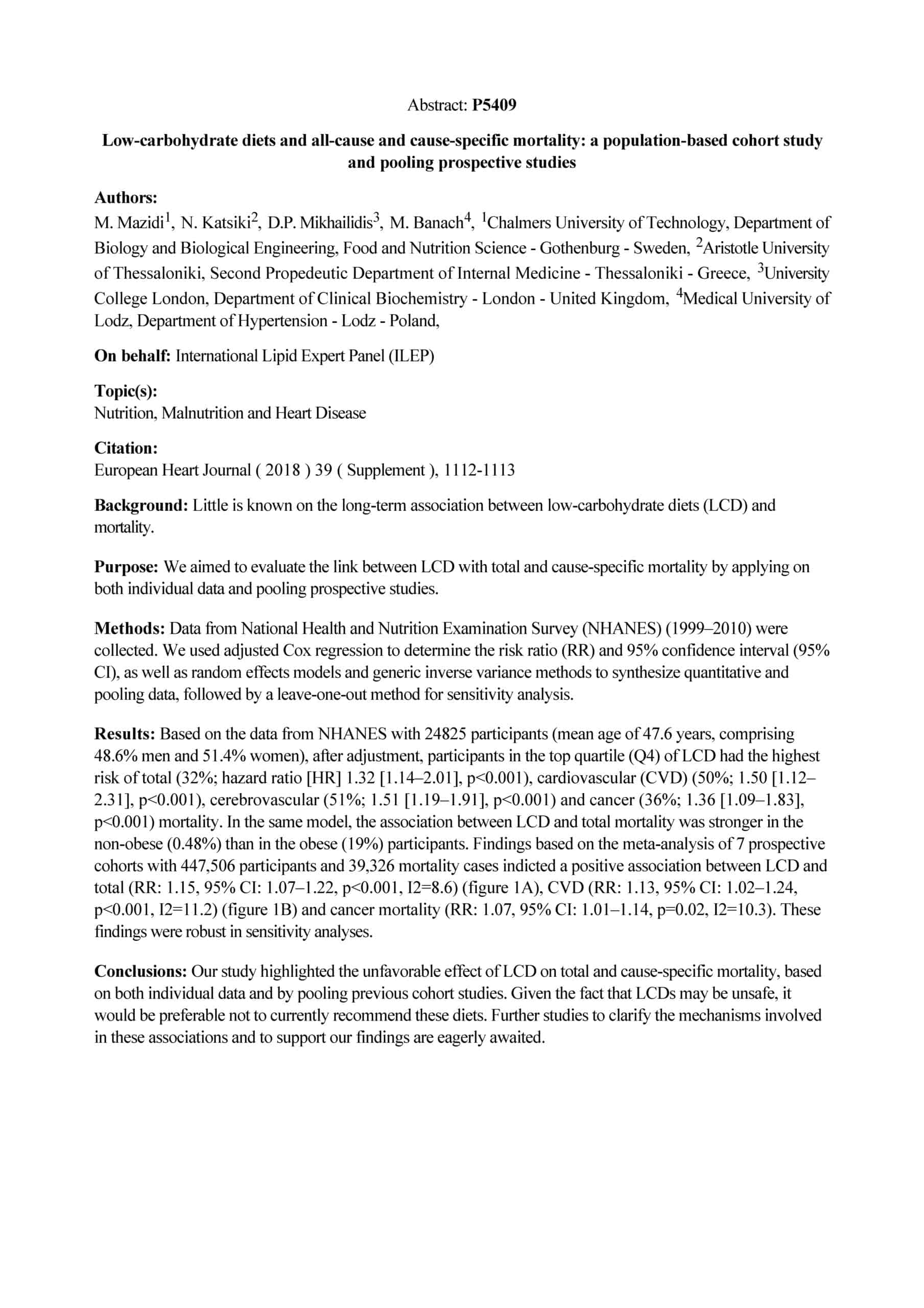
The Abstract (viewable below) is downloadable from the journal’s website and the 2018 Congress website and clearly indicates that it was a “Poster Session”.
A glaring omission from the Abstract is that it is not stated anywhere how many grams of carbohydrate per day is defined as a “low carbohydrate diet”.
The Abstract and supplied press materials claim that there is a relationship between “low carbohydrate diets” (not defined!) and death from all-causes, as well as specific death from coronary heart disease, cerebrovascular disease (stroke) and cancer and that the data analyzed was based on a representative sample of 24,825 participants of the US National Health and Nutrition Examination Survey (NHANES) from 1999 to 2010.
The researchers conclude that compared to participants with the highest carbohydrate consumption (also not defined!), those with the lowest carbohydrate intake had a 32% higher risk of all-cause death during the ~6.4-year follow-up. As well, the risk of death from coronary heart disease from “low carbohydrate”diets was 51% higher, from cerebrovascular disease (stroke) was 50% higher, and from cancer was 35% higher. They furthermore state that their results were confirmed by a pooled meta-analysis of 7 prospective cohort studies with 447,506 participants and which had an average follow-up of 15.6 years which indicated that risk of death from all causes resulting from “low carbohydrate diets” was 15% higher, from cardiovascular disease was 13% higher and from cancer was 8% higher compared to high carbohydrate diets.
Wait a minute…
The researchers found the risk of death from coronary heart disease and cardiovascular disease (heart attack and stroke) was ~50% higher and the pooled data of the studies they compared it to found a 13% higher incidence. Even without defining what a “low carbohydrate diet” is, a 50% increased chance of death is not comparable to a 13% increased chance of death. Similarly, the researchers found risk of death from cancer from a “low carbohydrate diet” was 35% greater and said their findings were comparable to an 8% higher incidence in the pooled data.
The researchers (1) did not define how many grams of carbohydrate per day was considered a “low carbohydrate diet” and (2) said their data was confirmed by studies that reported very different results.
Yet, they conclude;
Our study highlighted the unfavorable effect of low carbohydrate diets (LCDs) on total- and cause- specific mortality, based on both individual data and by pooling previous cohort studies. Given the fact that LCDs may be unsafe, it would be preferable not to currently recommend these diets. Further studies to clarify the mechanisms involved in these associations and to support our findings are eagerly awaited.
Which “low carbohydrate diet” did they study? How many grams of carbohydrate per day? We don’t know because the Abstract doesn’t say and the study hasn’t yet been published.
Some Final Thoughts…
It is not responsible journalism for the media to scream headlines warning of higher risk of premature death from “low carbohydrate diets” based on supplied press materials and an Abstract of a Poster Session of an unpublished study that doesn’t even define “low carb”.
Many studies and meta-analyses are using a low-carbohydrate or ketogenic dietary intervention that span 18 years and that are outlined in detail in 76 publications involving 6,786 subjects and that include 32 studies of 6 months or longer and 6 studies of 2 years or longer that demonstrate that low carb diets of a specified number of grams of carbohydrate per day are both safe and effective. You can read more about that here.
More Info
If you would like more information, you can learn about me here.
To your good health!
Joy
You can follow me on:
Twitter: https://twitter.com/jyerdile
Facebook: https://www.facebook.com/BetterByDesignNutrition/
Copyright ©2018 BetterByDesign Nutrition Ltd.
LEGAL NOTICE: The contents of this blog, including text, images and cited statistics as well as all other material contained here (the ”content”) are for information purposes only. The content is not intended to be a substitute for professional advice, medical diagnosis and/or treatment and is not suitable for self-administration without the knowledge of your physician and regular monitoring by your physician. Do not disregard medical advice and always consult your physician with any questions you may have regarding a medical condition or before implementing anything you have read or heard in our content.

Reference
Mazidi M, Katsiki N, Mikhailidis DP et al, Abstract (P5409): Low carbohydrate diets and all-cause and cause-specific mortality: a population based cohort study and pooling prospective studies, European Heart Journal, Volume 39 (Supplemental), pages 1112-1113.

I am a Registered Dietitian Nutritionist and the owner of BetterByDesign Nutrition Ltd. With a postgraduate degree in Human Nutrition and a background as a published mental health nutrition researcher, I have been dedicated to supporting my clients’ clinical needs since 2008.
I hold active professional licenses in BC (CHPBC), Alberta (CDA), and Ontario (CDO), allowing me to provide regulated Medical Nutrition Therapy across these provinces. My expertise spans chronic disease management, complex digestive health, and therapeutic diets. I am deeply passionate about helping people reclaim their health, rooted in my firm belief that Nutrition is BetterByDesign©.