
Note: This article is 1 of 6 articles that have been posted to this website and are in a separate category from research articles, and that category is called “A Dietitian’s Journey”. These 6 articles document my recovery from profound hypothyroidism (June 3, 2022 – October 31, 2022) and represent only my personal experience. They should not be treated as scientific evidence or medical advice.
A Dietitian’s Journey (Part I) documented my personal weight-loss and health-recovery journey (March 5, 2017 – March 4, 2019) and is not posted on this web page.
Introduction
Three weeks ago, I wrote an article about how a diagnosis of hypothyroidism is made and why it takes until someone has been unwell for quite a while before they are finally diagnosed. In one sense, that article laid the foundation for this one.
Two years ago, in the summer of 2019, I was feeling fantastic and was in remission of type 2 diabetes and hypertension and was celebrating my “little black dress moment.”
In August 2020, I had what my doctor assumed was Covid (back pain, non-stop headache, and couldn’t stop shivering) and since at that point the line up for a nasal swab was 6 hours long due to one of the testing sites closing, my doctor recommended that I simply assume I was positive, and self-isolate for two weeks, which I did.
For many weeks afterwards, I had overall muscle pain and weakness, as well as tingling and numbness in my fingertips, what is referred to as “brain fog”, and unbelievable fatigue. I went from being reasonably active and fit in the spring, to finding it difficult to even walk up or down a flight of stairs by August. Covid was new at that point, so none of us knew what to expect, but it took months until I began to feel reasonably normal. I learned to live with the muscle aches, joint pain, ‘brain fog’, and fatigue. The joint pain persisted for a long time, and was assumed to be post-viral arthritis as I had this once before when I had rubella as an adult.
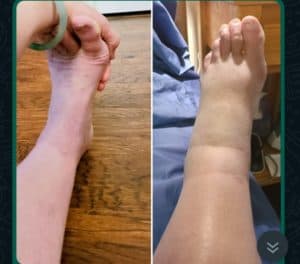
Despite having had both vaccines (April 2021, July 2021), in March of 2022, I came down with what my doctor assumed was Covid again. At first, the symptoms were pretty much the same as in August 2020, muscle aches and joint pain, being exhausted, feeling cold all the time and my lips were frequently blue, but I did not have a headache. I was loaned an oximeter by a family member who is a nurse and I found it quite strange that my body temperature was always two degrees below normal even though I had fever-like symptoms of being cold and shivering. The muscle aches were significant, as was the fatigue, but since these are also symptoms of Covid, I didn’t think much of it. It was only when I began to develop symptoms that were not associated with Covid that I began to become concerned. One of those symptoms was non-pitting edema in my lower legs and feet, and I don’t mean just a little bit of swelling. Below is a picture of before, and during;
Progressive Symptoms
I ordered compression stockings on-line and wore them daily to help keep the swelling down, but carried on working and writing the book, even though I was very tired all the time. I also began to have a very weird sensation in my mouth – my tongue became enlarged, and the salivary glands under my tongue were swollen. Since both of these affected my sense of taste, I thought this may be related to Covid, but then it progressed to the point where I found it difficult to talk properly because my tongue seemed too big for my mouth. I also began losing hair, but this had occurred several years ago, too. At the time, my TSH was “in the normal range”, so no further testing was done. In retrospect, the subclinical problem with my thyroid has been going on quite a while. Sometimes it would be worse than others, which is not unusual.
Connecting the Clinical History
After doing some reading in the scientific literature, as well as chatting with a couple of functional medicine doctors, I began to think that my symptoms were consistent with hypothyroidism. In addition, I knew that when I was in my early 20s I had a benign tumour removed from the isthmus of my thyroid and as part of the pre-surgery work up, I had an x-ray that required me to drink radioactive iodine. It wasn’t known at the time but it is known now that both the surgery on the thyroid (even though it remains largely intact), as well as the exposure to high doses of radioactive iodine can initiate a process that can lead to hypothyroidism years later.
It is also apparently possible that having had Covid back in 2020 may have initiated it and/or it may have been initiated as a response to the having the vaccines. I am not blaming either the virus or the vaccines because my thyroid surgery and exposure to high doses of radioactive iodine predated this by decades, but they may have been the precipitating event to symptoms. It is also possible that symptoms would have started on their own simply as a result of age.
I knew I was unwell and needed to see my doctor in person. In the meantime I began using some supplements that are involved in thyroid metabolism, such as kelp (for iodine), selenium and some other nutrients and while they helped a little bit, it was not significant. After doing a great deal of reading in the literature and listening to several medical presentations, I decided while waiting to see my doctor that I would try using a very small amounts of another type of supplement to see if it made any difference in my symptoms. I introduced it at half the rate and half of the dose usually used because (1) I had not yet seen my doctor and (2) I was aware that use of this supplement was not something to be taken lightly.
Meeting with the Doctor and Lab History
This morning I saw my doctor for the first time since Covid began. I had sent him a fax last week outlining the ways I had improved because I knew it was too much information for a 10 minute visit. I explained that I was feeling significantly better. My face swelling had gone down a great deal, the edema in my legs had almost disappeared. The skin on my legs is still very tight and shiny, but no edema. I lost 5-6 pounds of water-weight and most noticeable, the muscle weakness is gone!
When my doctor entered the examining room, he said he had just re-read the fax and based on what I wrote, he thinks it is very likely that I have hypothyroidism. He looked at the pictures I had on my phone —ones I had taken of my legs, my tongue, my face. After examining me, he pointed out several other physical symptoms that I have that are quite consistent with hypothyroidism, and said “Joy, I think your conclusion is right on.”
My doctor then brought up my past lab work on his screen and remarked that my TSH has been “high normal” since 2013, and that I often had low ferritin with no explanation, as well as past “unexplained” issues with hair loss. I had nine years with subclinical symptoms but no testing could be done because as indicated on the lab test results below “The free T4 was cancelled. The protocol recommends no further testing.”
I mentioned to him that I wondered what the results would have shown if my T3 or T4 were tested in 2013, or 2015, when my TSH was high-normal. He replied “unfortunately, unless someone has clear symptoms that are consistent with hypothyroidism there is nothing we can do, but your symptoms are very consistent now, but I think this diagnosis was a long time coming.”
A Shift in Clinical Approach
I was delighted by his response. He has been my doctor for 20 years and was not receptive to my use of a low carb and then a ketogenic diet to put my type 2 diabetes into remission. Today he was very different. When I asked if he was going to refer me back to the endocrinologist, he said “No. I don’t believe in changing something that is clearly working. I want you to keep taking what you’re taking in the same amount you are now, and I am going to run some lab work to see if you have gotten the amount right.” He even agreed to add a fasting insulin test, without any protest!
I guess if I can change how I practice dietetics based on new evidence, so can my doctor. We need them to oversee our care, and maybe just maybe in the process of interacting with some patients, they learn something they didn’t before. The bottom line was that I needed my doctor to know what I was doing and to examine me and make sure I was not doing something that could cause me harm.
I do not believe that self-treating is ever advisable, and certainly, if it were not for Covid and my doctor not having in-person office hours unless it was an emergency, I would have gone to see him months ago. I know once we get the levels of thyroid hormones right, that losing the 20 pounds I gained over the pandemic will be possible, but in the meantime, it is no small matter that I got my life back!!
A Dietitian’s Journey continues…
To your good health,
Joy
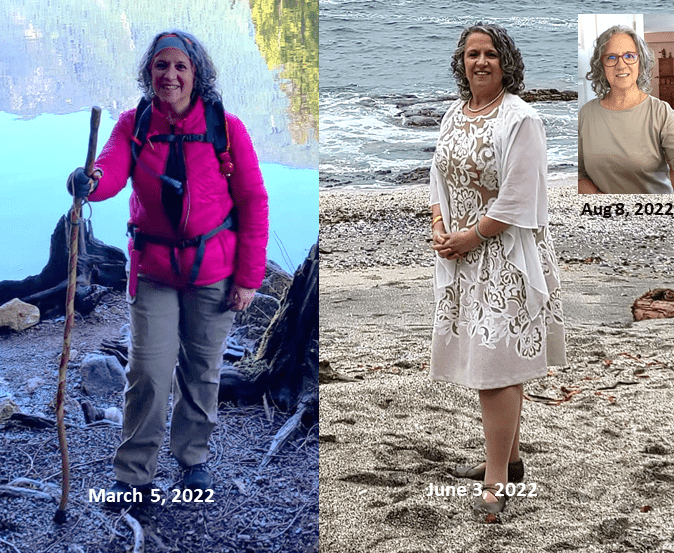
I don’t post the comparison picture below easily. It is very hard for me to see how bad I looked, but it is important to see just like the leg pictures, above. The photo on the right was taken at my youngest son’s wedding, June 3, 2022 (exactly 2 months ago) at the height of my hypothyroid symptoms. The photo on the left is a selfie I took today, August 5, 2022, almost exactly two months later.

© 2025 BetterByDesign Nutrition Ltd. All rights reserved.
I am a Registered Dietitian Nutritionist and the owner of BetterByDesign Nutrition Ltd. With a postgraduate degree in Human Nutrition and a background as a published mental health nutrition researcher, I have been dedicated to supporting my clients’ clinical needs since 2008.
I hold active professional licenses in BC (CHPBC), Alberta (CDA), and Ontario (CDO), allowing me to provide regulated Medical Nutrition Therapy across these provinces. My expertise spans chronic disease management, complex digestive health, and therapeutic diets. I am deeply passionate about helping people reclaim their health, rooted in my firm belief that Nutrition is BetterByDesign©.