
Introduction
Hair loss can be a very distressing symptom, especially when it is noticeable to ourselves and others. However, before outlining strategies for addressing it, we first need to understand what’s causing it. That is the purpose of this article. The next article will address strategies for helping to restore hair loss through diet and nutrient supplementation.
There are different types of hair loss with various causes, including genetic, autoimmune, severe stress, as well as nutrient deficiency and nutrient excess. Below are a three of the most common types of loss.
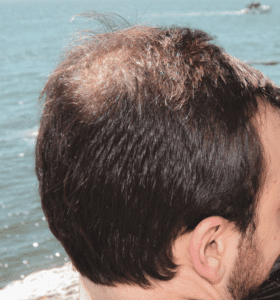
- Male pattern baldness
Androgenic Alopecia is the most common type and affects up to 50% of men and women [1]. In men, it is called ‘male pattern baldness,’ and is mainly seen on the crown of the head and on the temples. In women, it is called ‘female pattern baldness,’ and is mainly seen at the crown of the head, with a wider center part [2]. Androgenic alopecia is a genetic disorder that involves both maternal (mother’s) and paternal (father’s) genes, with sons being 5-6 times more likely to have it if their fathers were balding [1]. Since it is genetic, there is no ‘cure,’ but growth may be improved by using products such as minoxidil (Rogaine®) or rosemary extract which has been found to be as effective as minoxidil in studies [2]. One drawback is that treatment needs to continue indefinitely or loss will reoccur when treatment is discontinued [6].
Autoimmune and Stress-Induced Hair Loss
Alopecia areata is an autoimmune disorder where the body’s immune system attacks the follicles. Hair often comes out in clumps, usually the size and shape of a quarter but it can affect wider areas of the scalp [3]. It can occur in those who already have some form of autoimmune conditions, including thyroid disease. Treatment may involve use of oral or topical corticosteroid medication [3] which are very powerful anti-inflammatory medications, or other medications used in autoimmune conditions. Individual bald spots may be treated using Minoxidil (Rogaine®) [3].
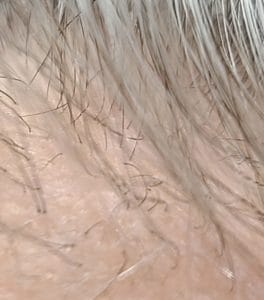 Telogen effluvium – is the most common form of diffuse hair loss [7]. It usually occurs after a profound stress, shock or traumatic event including after childbirth, as the result of a thyroid disorder, as well as rapid weight loss. It has been reported after a sudden and significant calorie restriction diet (“crash dieting”) [8], and has also been reported associated with the popularized ‘keto’ diet [9,10], but I am in agreement with Dr. Stephen Phinney of Virta Health that it should not occur in a well-designed keto diet [11].
 In telogen effluvium, hair often comes out in clumps in the shower, or in a brush [6]. Loss is usually from all over the scalp, but may occur more on the temples, the part and the crown of the head [7]. Once the cause telogen effluvium is removed, regrowth will usually begin within two to six months [6].
The Phases of Hair Growth
There are three phases of growth; the growth (anagen) phase, the transition (catagen) phase, and the resting (telogen) phase [5]. During the growth phase, follicles produce a shaft beginning from tip to root [5]. During the catagen and telogen phases, the follicles reset and prepare to start making a new hair.
Normal Hair Loss vs Hair Loss in Telogen Effluvium
Normally, 90-95% of follicles are in the growth (anagen) phase, with only 5–10% being in the resting (telogen) phase. Only a few follicles are in the transitional (catagen) phase [7] at any one time. At the end of the telogen phase, the hair falls out, and under normal circumstances, that would amount to ~ 100-150 hairs per day [7].
In telogen effluvium, the growth (anagen) phase slows down, and up to 50% of the follicles move into the telogen phase, where shedding occurs. i.e., loss becomes 5-10 times greater than normal, with people losing up to 50% of their hair. Since the period of the most dramatic loss occurs approximately 2-3 months after the triggering event, many people don’t relate the shedding to the event that caused it.
Identifying the cause of hair loss is essential, as once identified and corrected, regrowth will occur [7], but it can take 3-6 months for hair shedding to stop. While many people are anxious that they will go bald, hair loss does not usually exceed 50% of their hair [7]. Once the cause is identified and corrected, regrowth can begin to be seen 3-6 months later [7], but significant regrowth can take 12-18 months [7].
Medications that can interfere with hair regrowth include beta-blockers such as metoprolol and propranolol used in the treatment of abnormal heart rhythms, after a heart attack, or high blood pressure, anti-thyroid medication used in the treatment of hyperthyroidism, and anticoagulants [7].
As outlined in this previous article, hair loss is one of the identifying markers of hypothyroidism that results from a lack of thyroid hormones. Hair growth will begin to occur once optimal thyroid hormone replacement is reached, as mentioned above, it may take 3-6 months for hair shedding to stop, and another 3-6 months for regrowth to be able to be seen [7]. For someone dealing with hair loss, six months to a year to begin to see hair growth can seem like an eternity.
[I understand this firsthand, as the two photos below are of me. The one on the left was takenat the beginning of June 2022 at my youngest son’s wedding — a few weeks before being diagnosed with profound hypothyroidism. The photo on the right was taken yesterday, September 3, 2022, exactly three months later. I share these photos so that people can better understand what the hair loss associated with hypothyroidism may look like.]
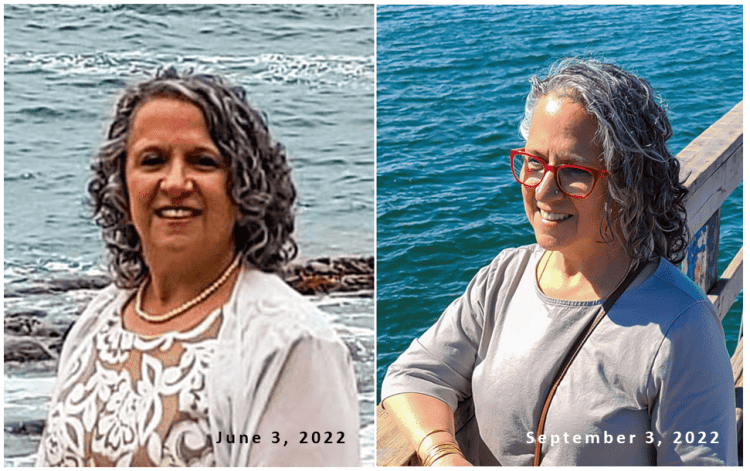
- Hair loss 3 months after diagnosis
Dr. Izabella Wentz, a clinical pharmacist who focuses on thyroid disorders, believes that hair loss is best improved on a medication that contains both T4 and T3, such as desiccated thyroid extract like WP Thyroid®, Nature-Thyroid® or Armour Thyroid®, or a mixture of T4 medication (such as Synthroid®) and a T3 medication such as Cytomel®. Dr. Wentz also provides a general “rule of thumb” that TSH after treatment should be between 0.5 and 2 μIU/mL [12].
Hair Loss in Nutrient Deficiencies and Nutrient Excess
There are specific nutrient deficiencies that are also linked to different types of hair loss, with the most well-known being iron deficiency. Vitamin C deficiency is also a factor, as it is needed for intestinal absorption of iron. Zinc deficiency, as well as some B-vitamin deficiency (e.g. niacin, biotin, riboflavin), as well as vitamin D deficiency, can also be associated with hair loss [13]. As importantly, excess in vitamins such as vitamin E, vitamin A, and folic acid are also associated with hair loss [13]. Ensuring adequate but not excessive nutrient intake is essential, and this will be covered in the next part of this article.
Final Thoughts…
Hair loss can be a very distressing symptom, especially when it is noticeable to ourselves and others. Once the cause has been identified and treated, all we do is be patient and wait for the hair to grow.
Hair regrowth can be supported by ensuring a nutrient-adequate diet, as well as with nutrient supplementation, when there is a nutrient deficiency. This will be the topic in Hair Loss – Part 2.
More Info
You can learn about me here. To learn about the support that I can provide to help you ensure that you have adequate intake of nutrients required to convert inactive thyroid hormones (fT4) into their active form (fT3), please view my Hypothyroid Management Package here.
To your good health!
Joy
You can follow me on:
Twitter: https://twitter.com/jyerdile
Facebook: https://www.facebook.com/BetterByDesignNutrition/
References
- Ho CH, Sood T, Zito PM. Androgenetic Alopecia. [Updated 2021 Nov 15]. In: StatPearls [Internet]. Treasure Island (FL): StatPearls Publishing. [https://www.ncbi.nlm.nih.gov/books/NBK430924/]
- Panahi Y, Taghizadeh M, Marzony ET, Sahebkar A. Rosemary oil vs minoxidil 2% for the treatment of androgenetic alopecia: a randomized comparative trial. Skinmed. 2015;13(1):15-21. [https://pubmed.ncbi.nlm.nih.gov/25842469/]
- Medical News Today. Alopecia areata: Causes, diagnosis and treatments. [Updated 2022 Apr 7]. [https://www.medicalnewstoday.com/articles/70956]
- Medical News Today. Is Telogen Effluvium reversible? [Updated 2018 Apr 23]. [https://www.medicalnewstoday.com/articles/321590]
- Alonso L, Fuchs E. The Hair Cycle. J Cell Sci. 2006 Feb 1;119(Pt 3):391-3. [https://doi.org/10.1242/jcs.02793]
- Phillips TG, Slomiany WP, Allison R. Hair Loss: Common Causes and Treatment. Am Fam Physician. 2017 Sep 15;96(6):371-378. [https://www.aafp.org/pubs/afp/issues/2017/0915/p371.html]
- Malkud S. Telogen Effluvium: A Review. J Clin Diagn Res. 2015 Sep;9(9):WE01-WE03. [https://doi.org/10.7860/JCDR/2015/15219.6492]
- Goette DK, Odom RB. Alopecia in crash dieters. JAMA. 1976 Jun 14;235(24):2622-3. [https://pubmed.ncbi.nlm.nih.gov/946924/]
- Dr. Sarah Hallberg: Do ketogenic diets cause hair loss? Virta Health. [https://www.youtube.com/watch?v=PxkfM84lxMU]
- Dr. Eric Westman: Hair Loss And Keto. Adapt Your Life. [https://www.youtube.com/watch?v=Cgv92mfTj4k]
- Phinney S. Does Keto Cause Hair Loss? Virta Health. [https://www.virtahealth.com/faq/keto-hair-loss]
- Wentz I. Hair Loss and Your Thyroid. Thyroid Pharmacist. [https://thyroidpharmacist.com/articles/hair-loss-and-thyroid/]
- Guo EL, Katta R. Diet and hair loss: effects of nutrient deficiency and supplement use. Dermatol Pract Concept. 2017 Jan 31;7(1):1-10. [https://doi.org/10.5826/dpc.0701a01]

© 2025 BetterByDesign Nutrition Ltd. All rights reserved.

Joy is a Registered Dietitian Nutritionist and owner of BetterByDesign Nutrition Ltd. She has a postgraduate degree in Human Nutrition, is a published mental health nutrition researcher, and has been supporting clients’ needs since 2008. Joy is licensed in BC, Alberta, and Ontario, and her areas of expertise range from routine health, chronic disease management, and digestive health to therapeutic diets. Joy is passionate about helping people feel better and believes that Nutrition is BetterByDesign©.