
Last clinically reviewed by Joy Y. Erdile, MSc, RD on April 23, 2026.
Introduction
The previous article titled “Hair Loss – Root Causes” was about the three most common types of hair loss, including androgenic alopecia, alopecia areata, and the most common form of diffuse hair loss, telogen effluvium, which is the type often associated with hypothyroidism. This article explains the role of specific vitamin and mineral deficiencies in hair loss and how treating them can help restore hair growth.
As explained in a previous article, telogen effluvium (TE) is the most common form of hair loss in hypothyroidism and is where the hair often comes out in clumps in the shower or with a brush. Hair loss is usually from all over the scalp but may occur more on the temples, the part, and the crown of the head [1]. In a study of more than 1200 people with thyroid disorder, half (50%) of people aged 40 years old and older had either alopecia areata or androgenetic alopecia [2].
What makes the hair loss associated with thyroid dysfunction particularly challenging is that it occurs 2-3 months after the overt symptoms of thyroid disorder begin, which is usually once they’ve already begun thyroid hormone treatment for hypothyroidism.
The pictures below are of me and are provided for illustrative purposes only. The one on the left was taken at one of my son’s weddings in June 2022, just before being diagnosed with profound hypothyroidism. The photo on the right was taken three months later, after beginning hormone replacement treatment, and the hair loss and shiny scalp are very apparent.
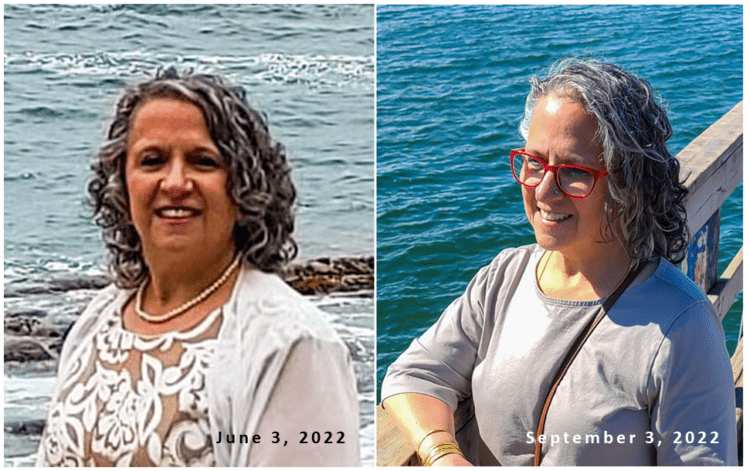
No hair loss at the height of untreated hypothyroidism, telogen effluvium hair loss 3 months later
Hair loss in hypothyroidism
Normally, 90-95% of hair follicles are in the growth (anagen) phase, with only 5–10% being in the resting (telogen) phase. Only a few follicles are in the transitional (catagen) phase [1] at any one time. At the end of the telogen phase, the hair falls out, and under normal circumstances, that would amount to ~100-150 hairs per day.
In telogen effluvium, the growth phase slows down, and up to 50% of the follicles move into the telogen phase, where shedding occurs. As can be seen in the photo above, at 3 months, I had lost 50% of my hair. It wasn’t only half the hair on my head that I lost, but also lost 1/2 my eyelashes and part of the outer third of my eyebrows.
Hypothyroidism can result in hair loss, but nutrient deficiencies can sometimes underlie hypothyroidism (such as iodine or iron deficiency). If any of these nutrients are found to be deficient or suboptimal, correct supplementation can support the regrowth of hair, but the timing of supplements with respect to thyroid medication is essential. Thyroid medication needs to be taken at least half an hour before food or vitamin/mineral supplementation, or two hours afterwards.
The Role of Iron and Selenium
Iron deficiency is very common, and one of the deficiencies that contributes to telogen effluvium [3,4], and iron is often low in hypothyroidism [5]. In some cases, treating iron deficiency may in itself be sufficient to restore thyroid function [5]. The body requires sufficient iron to convert inactive thyroid hormone (thyroxine/T4) into the active hormone (triiodothyronine/T3).
 It has been recommended that to reverse significant hair loss due to telogen effluvium, one should maintain serum ferritin at levels of >157 pmol/L (70 ng/dL) [4]. Best food sources of heme iron include oysters, clams, and liver. Vitamin C is also required for optimal absorption.
Selenium was identified in the 1990s as a component of the enzyme that activates thyroid hormone through the conversion of inactive T4 to active T3 [6]. Selenium is also used by the body for the formation of glutathione, a powerful antioxidant that protects the thyroid from inflammation and oxidative stress.
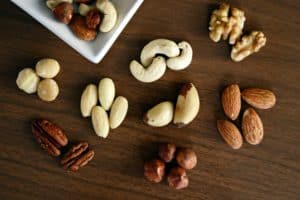 Food sources include Brazil nuts, with just 2 nuts meeting the daily requirement of 200 mcg. Other sources include mushrooms, eggs, and fish such as cod and halibut.
Zinc, Vitamin D, and Vitamin B12
Zinc plays a key role in the metabolism of thyroid hormones, specifically by regulating the enzymes involved in the activation of T4 to T3, as well as regulating thyrotropin-releasing hormone (TRH) and thyroid-stimulating hormone (TSH) synthesis [8].
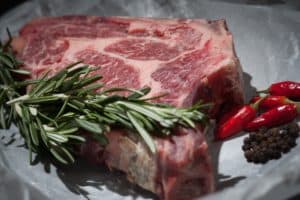 Good sources of zinc include red meat, poultry, and seafood such as oysters, crab and lobster. It is important to be tested first to know if there is a zinc deficiency before taking a supplement, as excess zinc can reduce copper levels.
Vitamin D – In Canada, between 70% and 97% of the population demonstrates vitamin D insufficiency [9]. It is now known that non-autoimmune hypothyroidism is associated with vitamin D deficiency [12]. A randomized trial found that supplementing with vitamin D improved TSH and calcium levels in hypothyroid patients [13].
 Naturally good sources of Vitamin D include fatty fish such as salmon, mackerel, and tuna.
Vitamin B12 – people with Hashimoto’s disease have a higher prevalence of pernicious anaemia [14], which is caused by a deficiency of vitamin B12. Vitamin B12 deficiency can mimic symptoms of hypothyroidism, such as fatigue and weakness. Best sources include organ meats, clams, sardines, and beef.
Hair Regrowth and Recovery
[UPDATE: December 11, 2022] The photo at the bottom was taken today — three months later. It clearly shows the regrowth of hair, which is the result of both hormone replacement treatment and three months of nutrient supplementation. Results will vary depending on individual nutrient deficiencies.
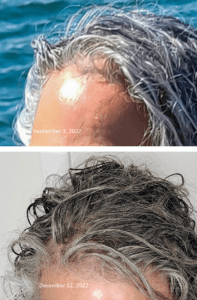
Hair regrowth after 3 months of thyroid treatment and nutrient supplementation
Below is a photo of eyelashes growing back in almost a month later (December 13, 2022), without any mascara or eyeliner.
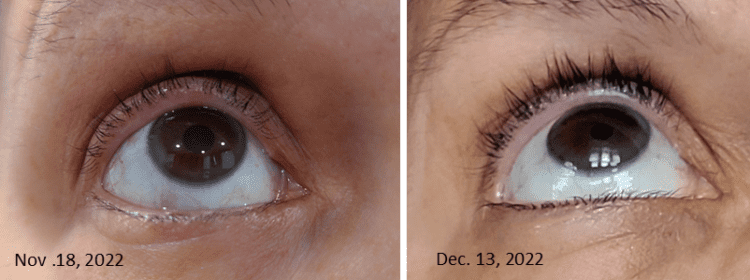
Eyelashes growing back in
Final Thoughts…
While treating hypothyroidism requires optimal thyroid replacement medication, determining if nutritional deficiencies are contributing to the condition is essential. Assessing dietary intake and conducting blood tests can support the recovery from hair loss. Remember that taking supplements wisely is key—nutrients like selenium can be toxic in excess, and biotin can interfere with thyroid hormone tests.
More Info?
If you have been diagnosed with hypothyroidism and would like to ensure you have adequate intake of nutrients known to be important in thyroid health, please view my Hypothyroid Management Package. Learn about me here.
To your good health!
Joy
You can follow me on:
Twitter: https://twitter.com/jyerdile
Facebook: https://www.facebook.com/BetterByDesignNutrition/
Quick Clinical Summary
Q: Why does hair loss happen in hypothyroidism?
A: Hair loss in hypothyroidism (telogen effluvium) often peaks 2-3 months after a physiological shift or the start of hormone replacement. This is because follicles move into the resting (telogen) phase before eventually shedding.
Q: How much iron (ferritin) is needed for hair regrowth in hypothyroidism?
A: Clinical recommendations suggest that to reverse significant hair loss from telogen effluvium, serum ferritin levels should be maintained at >157 pmol/L (70 ng/dL) to support both hair follicles and thyroid hormone conversion.”
Q: How does selenium support thyroid health?
A: Selenium is required for the enzymes that convert inactive T4 to active T3. It also aids in the formation of glutathione, a powerful antioxidant that protects the thyroid gland from oxidative stress and inflammation.”
References
- Malkud, S. (2015). Telogen Effluvium: A Review. Journal of Clinical and Diagnostic Research, 9(9), WE01-WE3. [https://pmc.ncbi.nlm.nih.gov/articles/PMC4606321/]
- Vincent, M., & Yogiraj, K. (2013). A descriptive study of alopecia patterns and their relation to thyroid dysfunction. International Journal of Trichology, 5(1), 57-60. [https://pmc.ncbi.nlm.nih.gov/articles/PMC3746235/]
- Almohanna, H. M., et al. (2019). The Role of Vitamins and Minerals in Hair Loss: A Review. Dermatology and Therapy, 9(1), 51-70. [https://pmc.ncbi.nlm.nih.gov/articles/PMC6380979/]
- Trost, L. B., et al. (2006). The diagnosis and treatment of iron deficiency and its potential relationship to hair loss. Journal of the American Academy of Dermatology, 54(5), 824-844. [https://pubmed.ncbi.nlm.nih.gov/16635664/]
- Ghiya, R., & Ahmad, S. (2019). SUN-591 Severe Iron-Deficiency Anemia Leading to Hypothyroidism. Journal of the Endocrine Society, 3(Suppl 1), SUN-591. [https://pmc.ncbi.nlm.nih.gov/articles/PMC6552785/]
- Winther, K. H., et al. (2020). Selenium in thyroid disorders — essential knowledge for clinicians. Nature Reviews Endocrinology, 16(3), 165-176. [https://pubmed.ncbi.nlm.nih.gov/31996813/]
- Mistry, H. D., et al. (2012). Selenium in reproductive health. American Journal of Obstetrics and Gynecology, 206(1), 21-30. [https://pubmed.ncbi.nlm.nih.gov/21798189/]
- Severo, J. S., et al. (2019). The Role of Zinc in Thyroid Hormones Metabolism. International Journal for Vitamin and Nutrition Research, 89(1-2), 80-88. [https://pubmed.ncbi.nlm.nih.gov/29954271/]
- Schwalfenberg, G. K., et al. (2010). Addressing vitamin D deficiency in Canada: a public health innovation whose time has come. Public Health, 124(6), 350-359. [https://pubmed.ncbi.nlm.nih.gov/20488494/]
- Forrest, K. Y., & Stuhldreher, W. L. (2011). Prevalence and correlates of vitamin D deficiency in US adults. Nutrition Research, 31(1), 48-54. [https://pubmed.ncbi.nlm.nih.gov/21310306/]
- Botelho, I. M. B., et al. (2018). Vitamin D in Hashimoto’s thyroiditis and its relationship with thyroid function and inflammatory status. Endocrine Journal, 65(10), 1029-1037. [https://pubmed.ncbi.nlm.nih.gov/29998918/]
- Ahi, S., et al. (2020). Vitamin D deficiency in non-autoimmune hypothyroidism: a case-control study. BMC Endocrine Disorders, 20(1), 41. [https://pmc.ncbi.nlm.nih.gov/articles/PMC7083169/]
- Talaei, A., et al. (2018). The Effects of Vitamin D Supplementation on Thyroid Function in Hypothyroid Patients: A Randomized, Double-blind, Placebo-controlled Trial. Indian Journal of Endocrinology and Metabolism, 22(5), 584-588. [https://pmc.ncbi.nlm.nih.gov/articles/PMC6238315/]
- Ness-Abramof, R., et al. (2006). Prevalence and evaluation of B12 deficiency in patients with autoimmune thyroid disease. American Journal of the Medical Sciences, 332(3), 119-122. [https://pubmed.ncbi.nlm.nih.gov/16969200/]

© 2025 BetterByDesign Nutrition Ltd.
I am a Registered Dietitian Nutritionist and the owner of BetterByDesign Nutrition Ltd. With a postgraduate degree in Human Nutrition and a background as a published mental health nutrition researcher, I have been dedicated to supporting my clients’ clinical needs since 2008.
I hold active professional licenses in BC (CHPBC), Alberta (CDA), and Ontario (CDO), allowing me to provide regulated Medical Nutrition Therapy across these provinces. My expertise spans chronic disease management, complex digestive health, and therapeutic diets. I am deeply passionate about helping people reclaim their health, rooted in my firm belief that Nutrition is BetterByDesign©.